GAS-VOCOff-Gas (Electrolyte Vapor) Detection Sensor
for stationary li-ion batteries & BESS
Detects li-ion off-gassing: Dimethyl Carbonate (DMC), Diethyl Carbonate (DEC) & Ethyl Methyl Carbonate (EMC).
Available in two versions: classic or daisy chained.
Calibration free.
Combined VOC, temperature & humidity sensing in one sensor.
UL 61010 recognized.
Patents pending.
Available in two versions: classic or daisy chained.
Calibration free.
Combined VOC, temperature & humidity sensing in one sensor.
UL 61010 recognized.
Patents pending.
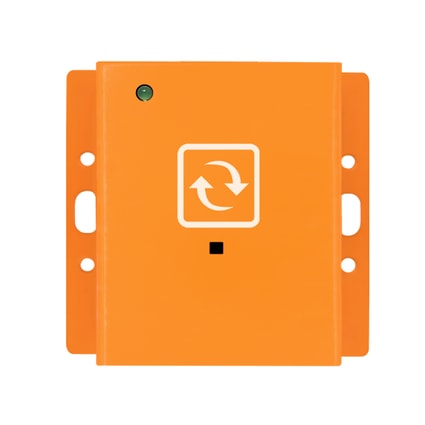
The GAS-VOC is available through OEM partners in select markets.
It is a monitoring sensor for early off-gas detection. It is not a fire detection, life safety, or suppression initiating system.
It is a monitoring sensor for early off-gas detection. It is not a fire detection, life safety, or suppression initiating system.
Two Versions Available
Classic, for direct connection to the base unit or a hub — or daisy chained, with up to 12 sensors on a single chain.
First Venting & Off-Gas Detection
Electrolyte vapors are released long before smoke or fire. Detecting them early creates the window needed to act on a cell before thermal runaway.
Calibration Free
No periodic calibration, no consumable cells to schedule and no recurring service visit for the VOC channel.
Flexible Integration
Plug and play into the base unit, which exposes readings and alerts over SNMP, Modbus TCP and BACnet IP.
Sensors Per Rack
One sensor per rack as a baseline, two on a full rack of batteries to stay closer to the source. Why rate of change matters more than the absolute VOC level.
UL 61010
Recognized to UL 61010 for the electrical safety of measurement and control equipment. Patents pending.
Prevent-iON® Mobile App
Test, inspect and diagnose the GAS-VOC in the field from an Android device — no PC required.
User Manual & Documentation
Mounting and placement, cabling for the classic and daisy chained versions, and commissioning the sensor on the base unit.
Technical Specifications
View detection ranges, accuracy, resolution and physical specifications for the GAS-VOC.
Two Versions: Classic & Daisy Chained
The GAS-VOC is offered in two versions. Both use the same sensing element and report the same measurements — they differ only in how they are wired into the installation.
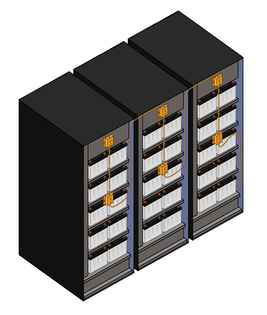
Classic
- Connects directly to a port on the base unit, or to a hub for additional port capacity.
- One cable run per sensor — the simplest option for a single cabinet, a small rack count, or a retrofit where cable routing is already in place.
- Plug and play: the base unit recognises the sensor on connection, no configuration required.
Daisy Chained
- Up to 12 sensors on a single daisy chain, consuming a single port on the base unit.
- Sensors are linked from one to the next, so a row of battery racks is covered with one cable run instead of one run per rack.
- Substantially reduces cabling, port count and installation time in multi-rack rooms and containerised BESS.
Which one? Choose classic when sensors are few and spread out; choose daisy chained when covering multiple racks in a row, where the saving on cable runs and base unit ports is significant.
First Venting & Off-Gas Detection
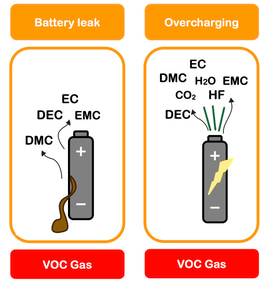 Lithium-ion batteries brought efficiency and compact storage to energy storage systems, but also introduced the risk of thermal runaway — uncontrolled overheating that can lead to fire or explosion, usually triggered by a malfunction, overcharging or physical damage.
Volatile Organic Compounds are released when a li-ion cell is stressed or damaged, well ahead of smoke or flame. They are the earliest reliable signal available. Detecting them allows a timely intervention — isolating or shutting down the affected unit — before the event escalates.
- Targeted chemistry: designed for the carbonate electrolyte vapors released during first venting — DMC, DEC and EMC.
- Stage 2 coverage: catches the venting event itself, not the fire that follows it.
- Combined with H2: pairing off-gas with hydrogen detection gives both the earliest warning and confirmation as the event develops. See the R-GAS-FLAMMABLE for combined VOC and hydrogen sensing.
Deployment Guidance
For effective coverage, install one GAS-VOC sensor per battery rack. On a full rack of batteries, two sensors per rack are recommended so that a sensor is always close to the source of the venting event.
- Proximity to the source: off-gas disperses and dilutes as it travels. On a fully populated rack, a single sensor can be several cells away from the one that vents. A second sensor keeps the detection point close to wherever the event starts, top or bottom of the rack.
- Rate of change over absolute level: a rising VOC index is far more informative than any single reading. Per-rack placement is what makes that trend meaningful — a shared sensor covering several racks dilutes the signal and delays detection.
- Localisation: per-rack sensors identify which rack is venting, not just that something in the room is.
- Cabling: the daisy chained version is designed for exactly this density — up to 12 sensors, so six fully populated racks at two sensors each, covered from a single base unit port.
- Placement: mount where vented gases will accumulate, following the airflow of the cabinet or enclosure.
Prevent-iON® Mobile App
The GAS-VOC is supported by the Prevent-iON® Mobile App, the dedicated Android companion app for Prevent-iON® detectors: Test. Inspect. Diagnose.
- Real-time graphing & trending of the VOC channel, plus temperature & humidity.
- Inspection: record gas (bump) tests and generate digital reports for your annual inspection trail.
- Diagnostics on site, without a PC.
- Requires the AX-USB-RJ45 adapter and an Android 8+ smartphone or tablet with USB OTG support.
